

To check an AC contractor's license in Texas, use the free License Search on the Texas Department of Licensing and Regulation (TDLR) website. Search by business name, license holder or license number, then confirm the license is active, the name matches the company and the expiration date is current before you sign a proposal.
Air conditioning and refrigeration contractors are licensed by the state, and taking a few minutes to look before you sign a proposal is one of the easiest ways to protect yourself on a large purchase.
This guide explains how the search works, what the license classes and endorsements mean, how federal refrigerant rules fit in, and the red flags worth watching for. It is general consumer advice for anyone hiring a contractor, in Starr County or anywhere else in Texas.
Why Texas licenses A/C contractors
Air conditioning work involves high-voltage wiring, pressurized refrigerant, gas connections on some heating systems and equipment that has to be sized and installed correctly to run safely. Texas law requires that a person or business contracting for that work be responsible through a TDLR air conditioning and refrigeration contractor license, often abbreviated TACL. Technicians who work under a licensed contractor are registered or certified with TDLR as well.
Licensed contractors also take on obligations the public can check, including carrying liability insurance at required levels, showing the license number on their paperwork and vehicles, and answering to TDLR if a complaint is filed.
How to look up a license on TDLR's website
- Go to TDLR's website and open the License Search tool.
- Choose the license type for air conditioning contractors (listed as an air conditioning and refrigeration contractor license, shown as AIRREF/TACL).
- Search by business name, by the license holder's last and first name, or by license number if you have it. You can also narrow the search by city, county or ZIP code.
- Review the result. It shows the license holder's name, license number, license type, expiration date and address.
- Compare those details with what the contractor gave you. The name on the license may be an individual rather than the company, so ask who the company's license holder is.
TDLR's search returns active licenses. If a contractor does not appear, check spellings and search again by the person's name before assuming the worst. TDLR also publishes enforcement actions, which you can review separately.
Reading the license number
A full TACL number shows the license class and endorsement. Here is what the parts mean.
| Part of the license | What it tells you |
|---|---|
| Class A | Allows work on systems of any size |
| Class B | Covers cooling systems of 25 tons and under and heating systems up to 1.5 million Btu per hour; enough for nearly all homes |
| Endorsement E (environmental air conditioning) | Comfort heating and cooling for people, such as homes and offices |
| Endorsement R (commercial refrigeration) | Walk-in coolers, freezers and refrigerated equipment |
| Endorsement C | Combined E and R |
| Expiration date | License must be current on the day work is done |
A residential AC installation or repair generally falls under the environmental air conditioning endorsement. If you need a walk-in cooler or commercial refrigeration work, look for the refrigeration or combined endorsement.
Where the license number should appear
TDLR rules require licensed contractors to display information you can verify without asking:
- On vehicles: the license number and company name on both sides of trucks used for contracting work.
- In advertising: the license number on most ads soliciting business, with limited exceptions.
- On proposals and invoices: the company name, address, phone number and license number, plus a notice stating that the work is regulated by TDLR along with the agency's contact details.
You are also entitled to ask for the company's liability insurance carrier and policy information, and a licensed contractor is expected to provide it.
EPA Section 608 and refrigerant
State licensing is not the only credential that matters. Under federal EPA Section 608 rules, technicians who open the refrigerant circuit on air conditioners must be certified. Residential split systems fall under Type II certification (high-pressure equipment), and Universal certification covers all types.
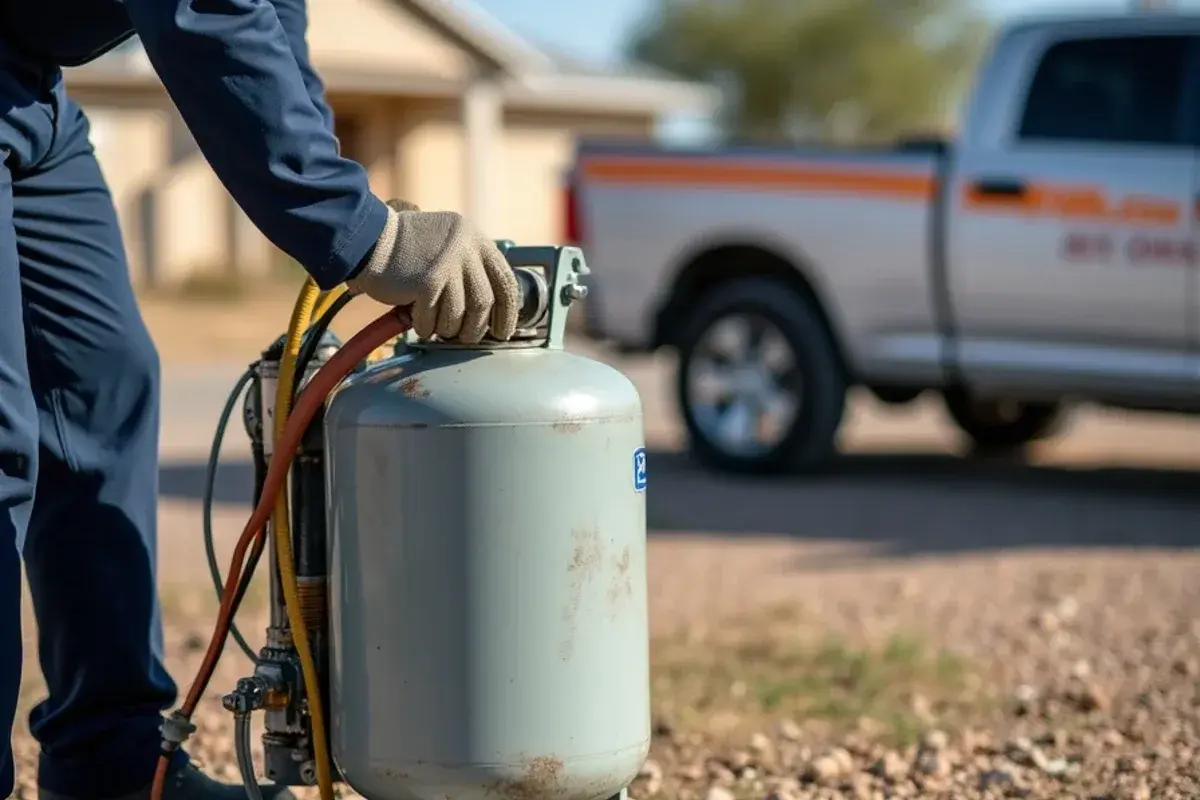
Section 608 also requires refrigerant to be recovered rather than vented when a system is opened or removed. When you replace an old AC, ask how the refrigerant in the old unit will be recovered. Any contractor should be able to answer clearly.
What a license proves, and what it does not
A license check is the floor, not the whole inspection. Knowing its limits helps you use it well.
It proves accountability. An active contractor license means a named person met the state's experience and exam requirements, and that the business answers to TDLR if something goes wrong. That matters most when a job turns into a dispute.
It does not tell you who shows up. The license belongs to the contractor. The people working on your system are supposed to hold their own TDLR designation, either the registered technician designation or the certified technician tier, which is voluntary and requires more training. Both renew every year and both work under a licensed contractor's supervision. You can ask for a technician's name and look it up in the same search.
It does not measure workmanship. A licensed contractor can still oversize a system, skip a load calculation or reuse a line set that should be replaced. Judge the quote on its scope: whether anyone measured the house, looked at the ducts and the electrical, and explained the matched equipment. A license tells you a complaint can be filed; the estimate visit tells you how the job will be done.
The homeowner exemption is narrow. TDLR does not require a license for someone working on a home they own and live in. That exemption does not cover a friend or a relative doing the work for you, and it does not waive city permits or inspections. Federal refrigerant rules still apply too, which is why buying and charging refrigerant is not a do-it-yourself step.
Expired is not the same as never licensed. A license that lapsed recently may simply be awaiting renewal, while one with enforcement orders tells a different story. TDLR's enforcement search shows final orders, which is worth a look before a large job.
Red flags when hiring
| Warning sign | Why it matters |
|---|---|
| No license number on the truck, ad or proposal | Required for licensed contractors; its absence is worth questioning |
| Name on the license does not match the business | Ask who the license holder is and how the company is affiliated |
| Quote given without looking at the house | Sizing, ducts and electrical work cannot be judged from a phone call |
| Large cash deposit demanded before any work | Increases your risk if the job is never finished |
| Repeated refrigerant "top-offs" with no leak search | Refrigerant does not get used up; low charge means a leak |
| Door-to-door offers after a storm | Out-of-area crews may disappear when problems arise |
| Pressure to sign immediately | A fair offer will still be there tomorrow |
| Asking you to pull the permit in your name | Shifts responsibility from the contractor to you |
Questions to ask any contractor
- What is your TACL license number, and who is the license holder?
- Will technicians working on my system hold EPA Section 608 certification?
- Can you give me your liability insurance carrier and policy details?
- Will the proposal include the license number and the TDLR notice?
- Does my address need a permit, and who will get it?
- Who registers the equipment with the manufacturer for warranty coverage?
Local notes for the Valley
Rural addresses across Starr County may sit outside city limits, where permit rules differ from those inside a city, but the state license requirement applies everywhere in Texas. Homeowners near the county line, such as in Sullivan City, can use the same TDLR search to compare contractors from either side. For an overview of the heating, cooling and air quality services a contractor may offer, see our HVAC services page, and for what a complete new-system quote should include, see AC installation.
Check first, then compare
Before you hire anyone for AC work, look up the license on TDLR's site, confirm the name and expiration date, and make sure the number appears on the proposal. Ask about EPA Section 608 certification for anyone handling refrigerant and about insurance details. Those few minutes give you a solid basis for comparing quotes on price, scope and trust. If you are lining up bids for a new system or a repair, call 956 Multi Service at (213) 423-7827 and hold our itemized quote to the same checks as every other bid.