
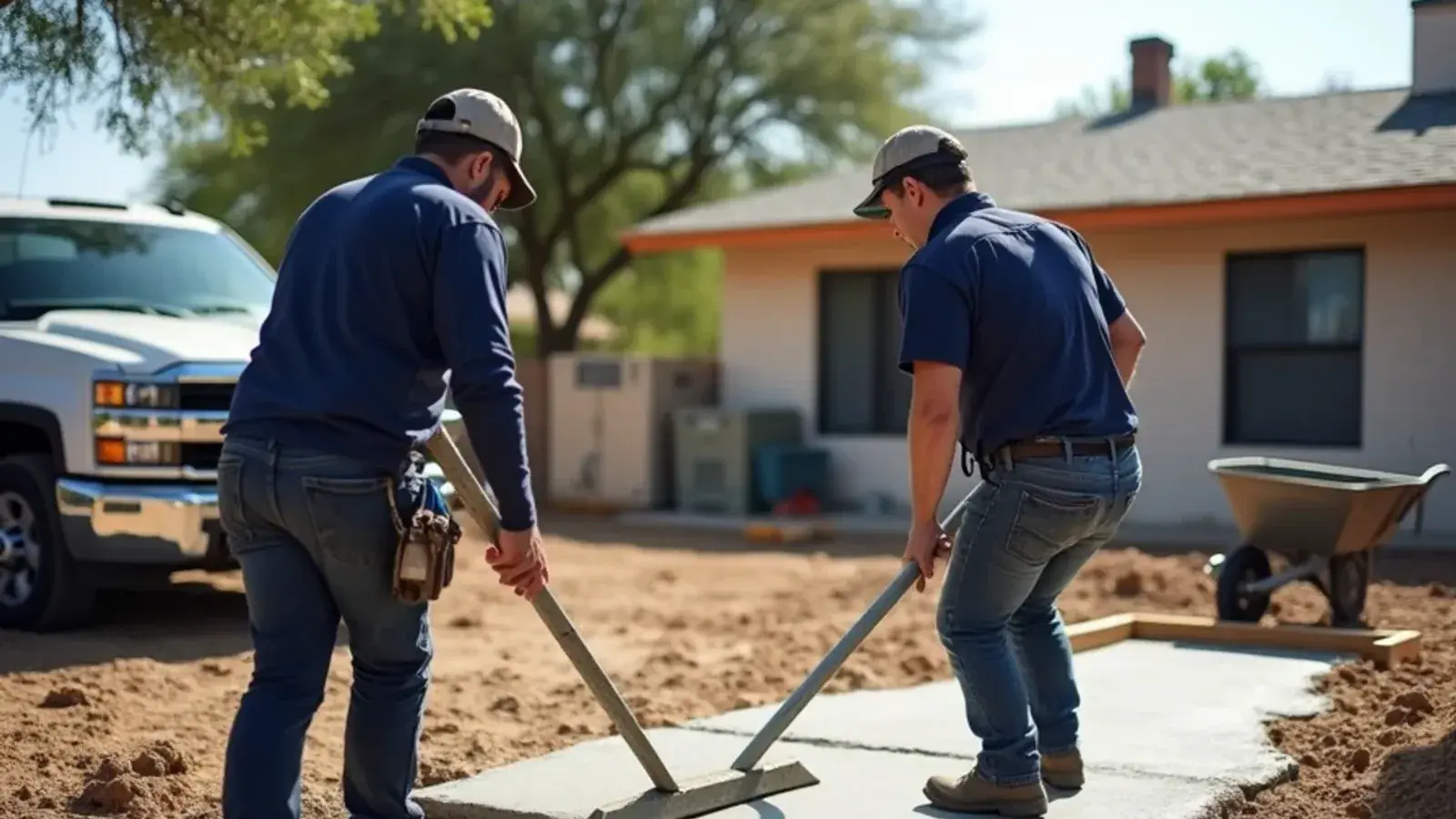
A good slab is mostly decided before the truck shows up. As a concrete contractor in Rio Grande City, we spend more time on the ground under the pour than on the pour itself, because caliche, pockets of expansive clay and summer heat are what crack Valley concrete early.
Our crew pours the small and mid-size jobs that homeowners actually need: a patio off the back door, a sidewalk to the street, a pad for a shed or water tank, a widened driveway, or a level base for an air conditioner. Because we also install and service AC systems, equipment pads are part of our everyday work rather than a side job.
Concrete installation: what we pour and where it fits
Each project type has its own thickness, reinforcement and finish. This table is a starting point for planning, not a final spec for your lot.
| Project | Typical use | Notes for planning |
|---|---|---|
| Patio | Outdoor seating, grill area, shade structure | Slope slightly away from the house so rain drains off |
| Sidewalk | Front entry, side yard path, path to a casita | Broom finish for grip, joints at regular spacing |
| Small slab | Shed, storage building, carport, water tank | Thickness depends on the load it will carry |
| Driveway section or approach | Widening, new parking spot, apron at the street | Thicker and reinforced for vehicles; street-side work may need approval |
| Equipment pad | AC condenser, mini-split, generator | Level, raised where water collects, sized to the unit |
| Steps and landings | Front and back doors | Formed risers, consistent step height |
Plenty of calls are as small as one pad behind a grandparent's house. Small pours still get the same base work as larger ones.
Every concrete job we take on includes:
- Layout and measuring on site, with slope checked before anything is dug.
- Base preparation: soft soil, roots and old concrete removed, base brought in and compacted.
- Forms and reinforcement set to grade, with steel on chairs where the slab calls for it.
- Pour and finish: screeded, floated, edged and broomed or troweled.
- Control joints and curing instructions you can follow after the crew leaves.
- Cleanup: forms pulled, spoil hauled off and the yard left usable.
How thick should a slab be on caliche and clay?
Three decisions shape how long the concrete lasts.
What is underneath
Much of Starr County sits on caliche, a hard, chalky layer of calcium carbonate that can be firm in one spot and crumbly a few feet over. Other lots have clay that swells when wet and shrinks during drought. We dig out soft or organic soil, bring in base material where needed and compact it so the slab bears evenly. Uneven support is the most common reason a new slab cracks in its first year.
Thickness and reinforcement
Walks and patios are usually thinner than anything that carries a vehicle. Driveway sections and slabs under heavy equipment get more thickness and more steel. Rebar set on chairs gives the most strength, welded wire mesh suits lighter flatwork, and fiber added to the mix helps control surface cracking. The point is to put the steel in the middle of the slab, not on the dirt.

Water and elevation
Concrete should shed water away from walls and doorways. On low lots near arroyos or the river, where Hurricane Hanna flooded yards in 2020, we raise pads and slabs and plan where runoff will go before we set the forms.
Pour day and the curing period
Here is how a typical job runs from the first visit to the day you can use it.
- Measure and plan. We mark the layout, check slope and confirm access for a mixer truck or smaller equipment.
- Excavate and prepare the base. Old concrete or sod comes out, base goes in and gets compacted.
- Set forms and steel. Forms are staked to grade and reinforcement is placed and tied.
- Pour and finish. We pour early in the morning during warm months, then screed, float and finish with a broom or smooth trowel.
- Cut control joints. Joints are tooled into the wet surface or saw-cut soon after. As a rough guide, joint spacing in feet stays within two to three times the slab thickness in inches.
- Cure. The surface is kept damp, and forms come off once the edges can stand on their own.

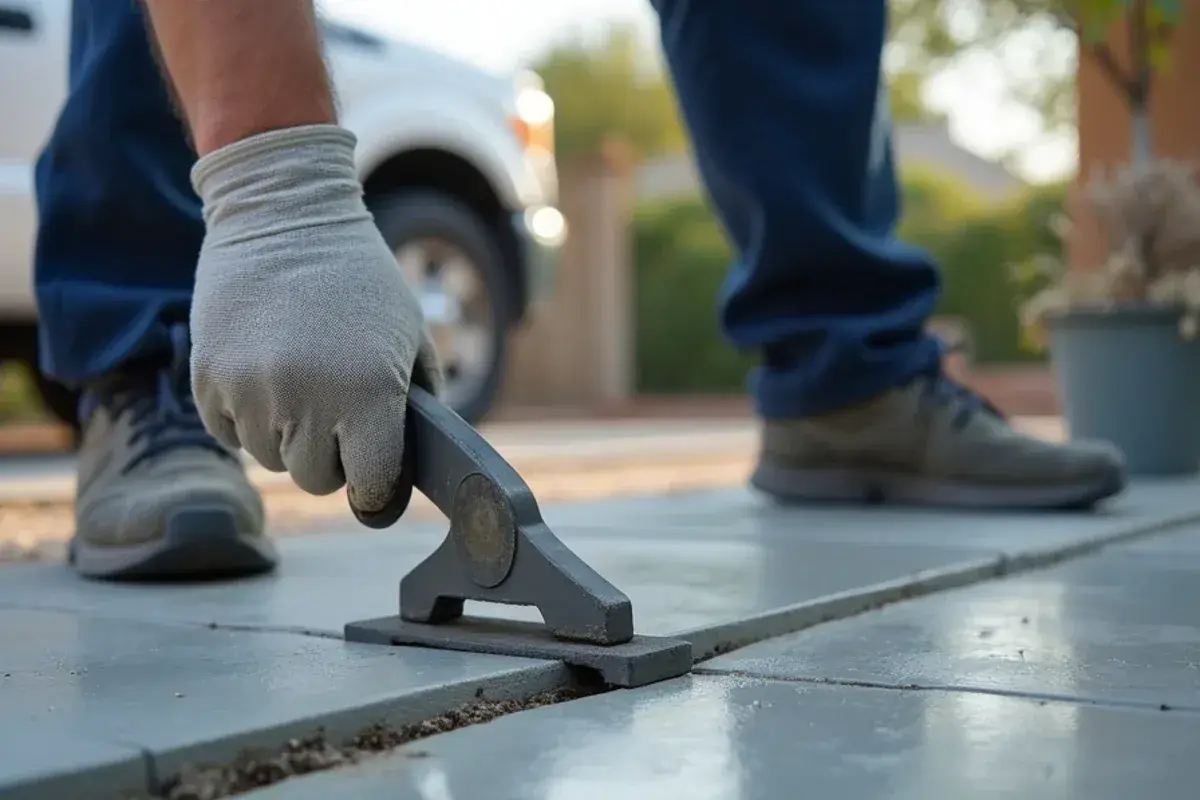
Heat is the biggest risk on a Valley pour. Concrete that dries too fast loses strength at the surface, which shows up later as dusting, flaking and random cracks. Midday pours in summer are best avoided, and we ask homeowners to keep the slab wet for the first several days if we cannot be there.

What drives the price of a concrete project
Every estimate is built from the specific site, so we price after measuring. The main factors are:
- Area and thickness, which together set how much concrete is ordered.
- Base work, including digging out soft soil and bringing in fill.
- Demolition and haul-off if old concrete has to come out first.
- Reinforcement type and the finish you choose.
- Access, since a truck that can back up to the forms costs less labor than wheelbarrows across a yard.
- Distance from Rio Grande City for rural lots across the county.
- Mix choices, such as added fiber or a retarder that slows setting on a hot morning.
- Pour size versus truck minimums, since a single small pad can cost more per yard than a patio.
- Permits, where a driveway approach or a structure requires one. Inside city limits the City of Rio Grande City sets those rules; elsewhere, ask Starr County.
Repairs, AC pads and the rest of the concrete family
Not every job starts from bare ground. If a walk is cracked, a step has broken corners or a driveway section has sunk, our concrete repair page explains when a fix makes sense and when a section should be replaced. If your condenser is leaning or you are adding a ductless system, our AC condenser pads page covers pad height, leveling and how we move the unit safely.
Larger projects often combine trades. A room addition needs a footing, a slab and an air conditioning plan, and our home construction and remodeling crew handles that as one job. We pour in La Grulla, B and E, Mi Ranchito Estate and the rest of Starr County.
Permits, 811 and right-of-way rules before a pour
Three outside rules can apply before forms go down. Texas law, as Texas811 explains it, requires whoever is digging to contact 811 at least two business days before excavating, even in a private backyard; ask your contractor for the ticket number. Private lines you own, such as a feed to a detached shed, are not marked by the utilities, so point those out.
A driveway that connects to a state highway, including US-83 and the FM roads, needs a TxDOT access driveway permit (Form 1058) before work starts in the right of way, and TxDOT inspects the finished apron. Inside Rio Grande City, Roma or another city, ask the city about permits for driveways, approaches and structural slabs. On rural lots, check with Starr County, especially for a building pad in a floodplain.
Why homeowners hire 956 Multi Service for concrete
Concrete is one of several trades our Rio Grande City crew handles, and that is the advantage: the people who set your AC condenser know exactly how big, how high and how level its pad needs to be. The business started in July 2024 and its Google profile shows a 5.0 average from 41 reviews.
Our concrete calls come in on the same line as AC calls, open 8 AM to 7 PM with Sundays closed, and we come out to measure before giving you a number. A single pad is easier to slot in; patios and driveways get booked around the weather and the truck. Cash, Discover, Visa, American Express and MasterCard are accepted, and financing is available for a bigger project.
Concrete Work: pick the service you need

Google reviews that mention work like concrete work
5.0 out of 5 from 41 Google reviews
“Great and dependable Service .Did my grandmothers concrete pad .Great professional Service !”
“After my mr. Cool Mini split ac went out nd Mr. Jesus Cantu was notified for Assistance, he suggested and advised on a confort AC mini split 2 ton Unit to cool off my living Quarters. Awesome results , Quick installation and proficient professional job . Very efficient and professional your man . Would recommend to Rio Grande Vally Whole..heartedly. don't fight the heat notify Jesus Cantu.”
“Very great customer service! Talked to them over the phone to explain my A/C situation I was having, and they knew what the problem was right away! Came to fix the problem in a timely manner! Recently I purchased a new unit and they went for an installation the same day! Highly recommended!”
What do people ask before hiring a concrete contractor in Rio Grande City?
What size concrete jobs do you take on?
We focus on residential and small-property work: AC and equipment pads, sidewalks, patios, small slabs for sheds or carports, steps, driveway sections and approaches, and repairs to existing concrete. For a large slab such as a full house foundation, tell us the size and use and we will be straight with you about whether it fits our crew or whether you need a larger outfit.
How long before I can drive or park on new concrete?
As a general rule, walking is fine after a day or two and a regular passenger car can usually park on it after about a week. Heavier trucks and trailers should wait longer, ideally close to the full cure period of about four weeks. Hot weather speeds up surface drying but not real strength, so keep traffic off it for the full time we give you at the end of the pour.
Do you pour pads for AC units and generators?
Yes. Equipment pads are some of the most common small pours we do, because the same crew installs and repairs air conditioners. We size the pad to the unit, set it level, slope the ground away from it and raise it on low or flood-prone lots. Generators, water tanks and mini-split condensers can all sit on a poured pad sized for their weight and footprint.
Will my new concrete crack?
Probably a little, and that is normal. Concrete shrinks as it dries, so hairline cracks are expected; control joints give them a planned line to follow. Cracks that widen, step out of level or keep growing point to a base problem, which on Starr County caliche usually means a soft pocket that was not dug out and compacted before the pour.
Can concrete be poured in Rio Grande City summer heat?
Yes, with the schedule built around the heat. Forms and base are set the day before, the truck is booked for first light, and the base is dampened so dry caliche does not pull water out of the mix. Finishing moves quickly, and the slab is kept wet afterward. Midafternoon pours in July and August are the ones to avoid.
Still have a question about concrete work? Ask us directly.
Call (213) 423-7827Where we handle concrete work
- Concrete Work in Starr CountyCaliche that is rock-hard in one spot and crumbly nearby makes base prep the core of every pour.
- Concrete Work in Las Lomas, TXHomes on the caliche hills need slabs graded so runoff heads downslope instead of under the patio.
- Concrete Work in El Refugio, TXLower ground toward the river calls for raised pads that keep equipment above standing water.
- Concrete Work in Garza-Salinas II, TXClosely spaced lots often mean wheelbarrow access instead of a truck chute.
- Concrete Work in Mi Ranchito Estate, TXA mobile home paired with a newer add-on often needs steps and a walk tying the two together.
- Concrete Work in B and E, TXOwner-built homes that grow room by room need footings and slabs that line up with the existing floor.
- Concrete Work in West Alto Bonito, TXNewer owner-built block homes here often still need a patio, front walk or carport slab finished out.
- Concrete Work in El Chaparral, TXMesquite and huisache roots must come out of the base, or they leave soft spots under the slab.
- Concrete Work in La Grulla, TXIrrigated farmland soil holds more moisture than upland caliche, so base material and compaction get extra attention.
- Concrete Work in Escobares, TXHomes strung along US-83 may need a TxDOT access permit before a new driveway connects to the highway.