
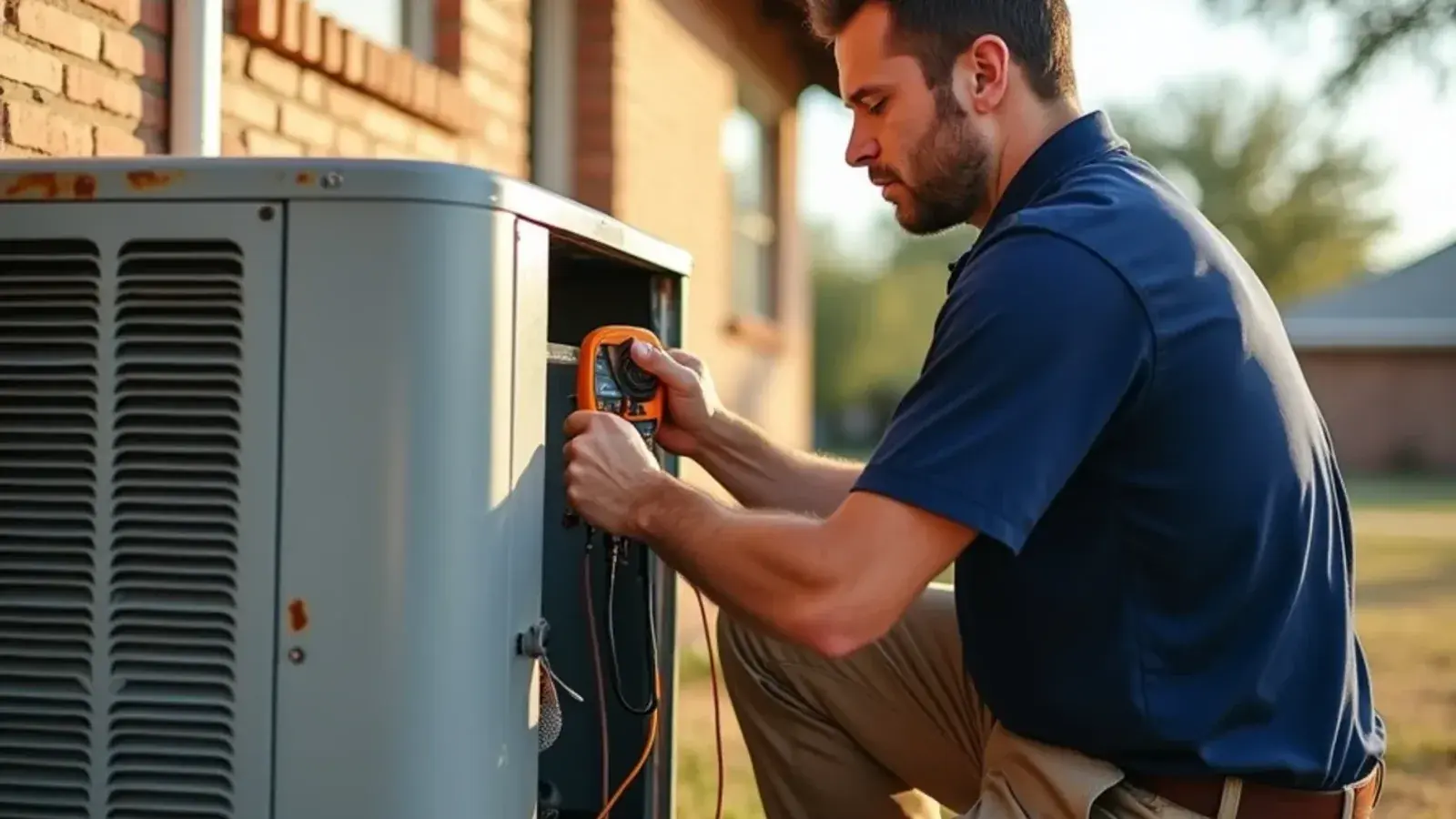
The main signs an AC compressor is failing are an outdoor unit that hums but will not start, hard starts that dim the lights, a breaker that trips again and again, weak or warm air, short cycling, new rattling or grinding, and oil stains or a burnt smell. Many of these trace back to cheaper parts, so testing comes first.
These warnings tend to show up gradually, then all at once. The compressor is the pump in the outdoor unit that pressurizes refrigerant so it can carry heat out of your house, and it is the most expensive single part in the system. Many of the symptoms that point toward it are actually caused by cheaper parts around it, so the goal of this guide is to help you recognize the warning signs and understand what a technician will test before anyone says the word "replace."
Seven warning signs to take seriously
The outdoor unit hums but does not start
A steady hum with nothing turning often means the compressor is trying to start and cannot. The most common culprit is a weak capacitor, which is an inexpensive part. A compressor with worn internals or a locked rotor can make the same sound.
It starts hard, with a clunk or a long stutter
If the outdoor unit grunts, shudders or takes several seconds to come up to speed, and the house lights dim when it kicks on, the compressor is pulling heavy starting current. That stresses wiring and the compressor itself.
The breaker trips again and again
A compressor with damaged windings or one that is shorted to ground can trip the outdoor breaker. Do not keep resetting it. One reset is reasonable; if it trips again, leave it off. Forcing power into a shorted motor can damage wiring and the panel.
Warm air or weak cooling
When the compressor loses its ability to pump, refrigerant pressures drop and cooling falls off. The fans run, but the air never gets truly cold.
Short cycling
The outdoor unit starts, runs for a minute or two and stops, over and over. An overheating compressor may be tripping its internal overload, which can come from a dirty coil, a bad fan motor, low refrigerant or the compressor itself wearing out.
New noises
Rattling, clanking or grinding from inside the cabinet, or a high-pitched squeal on startup, can mean loose mounts, worn bearings or internal damage.
Oil stains or a burnt smell
Oily residue around the base or the copper lines can signal a refrigerant leak, since oil travels with refrigerant. An acrid electrical smell may mean burnt windings or wiring.
What it might be instead
Before condemning a compressor, a good technician rules out the supporting parts. This table shows why.
| Symptom | Could be the compressor | Often something else |
|---|---|---|
| Humming, won't start | Locked rotor, worn internals | Weak or failed capacitor |
| Breaker trips | Windings shorted to ground | Loose or burnt wiring, failed contactor |
| Short cycling | Internal overload tripping from wear | Dirty condenser coil, failed fan motor, low refrigerant |
| Warm air | Worn valves, loss of compression | Refrigerant leak, frozen indoor coil, dirty filter |
| Clicking without starting | Internal failure | Contactor or thermostat wiring fault |
| Loud rattle | Broken mount or internal damage | Loose panel or fan blade |
How a technician confirms compressor trouble
Diagnosis involves several measurements, not a guess.
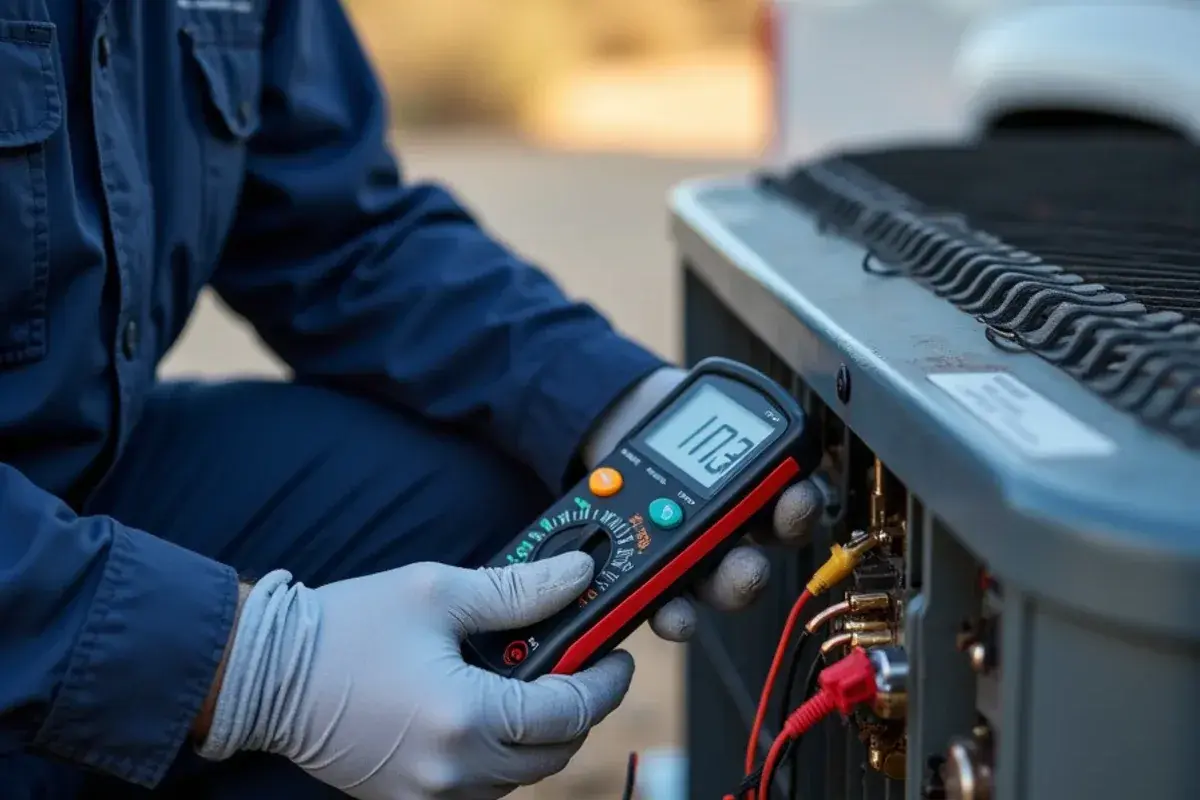
- Capacitor test. Comparing the capacitor's measured value with its rating is the first step, since a weak one mimics compressor failure.
- Winding resistance. With power off, the technician measures resistance between each pair of the compressor's three terminals, then checks each one against the metal shell. An open winding or a short to ground means internal failure.
- Amp draw. A clamp meter shows how much current the compressor pulls at startup and while running, compared with the manufacturer's rated values.
- Refrigerant pressures and temperatures. These show whether the compressor is actually moving refrigerant.
- Acid test. After a burnout, refrigerant oil can turn acidic. Testing tells the technician whether the system needs extra cleanup if a new compressor goes in.
Stay out of the electrical compartment
Capacitors can hold a dangerous charge even after the power is off, and compressor terminals can fail violently on a shorted motor. Leave panel removal and testing to a technician.Hard start kits: what they can and can't do
A hard start kit adds a capacitor and relay that give the compressor a stronger push at startup. On an aging compressor that struggles on hot afternoons, it can reduce strain and dimming lights. It does not fix internal wear. If a hard start kit is suggested, ask whether testing shows a healthy compressor that simply needs help starting, or a failing one.

Why compressors really fail, from the service side
A compressor seldom wears out on its own. When one fails, the cause is usually something around it that went unnoticed, and replacing the compressor without fixing that cause sets the new one up to fail the same way.
- Heat. A coil packed with caliche dust or a condenser fan that quit makes the compressor run hotter and trip its internal overload over and over. Each of those trips shortens its life.
- Liquid returning to the compressor. Compressors are built to pump vapor. When indoor airflow is poor, from a clogged filter or a dirty indoor coil, liquid refrigerant can reach the compressor and wash oil off its moving parts.
- Electrical wear. A contactor with pitted contacts can chatter, feeding the compressor uneven power at every start. A weak capacitor makes each start harder.
- Contamination. Moisture or air left in the lines after a repair or install, because the system was not pulled into a deep vacuum, mixes with refrigerant oil and slowly forms acid.
Trade-offs to weigh before a compressor swap
- Warranty helps less than it sounds. When a manufacturer warranty still covers the compressor, it usually covers the part, while labor, refrigerant and the filter drier fall to you.
- Cleanup after a burnout. If the old compressor burned out and the oil tests acidic, the system needs extra filtration, sometimes a suction-line filter drier, to protect the new one. Skipping that is a common reason for a second failure.
- Matching matters. New outdoor units now ship with lower-GWP refrigerants such as R-454B. Pairing one with an older indoor coil designed for a different refrigerant may not be possible or may not reach its rating, which is why a full system change is often quoted together.
None of this means replacement is always the answer. A compressor that tests healthy behind a failed capacitor or contactor can run for years once the part that was overworking it is fixed.
Repair the compressor or replace the system?
When the compressor itself has failed, you face a real decision. AC compressor repair means replacing the compressor, filter drier and refrigerant charge while keeping the rest of the system. That can make sense when:
- The system is fairly new and its compressor remains within the manufacturer's warranty period
- The rest of the equipment is in good shape
- The system uses a refrigerant that is still readily available
Replacement deserves a hard look when the system is old, the coils are worn, or it runs R-22. R-22 has not been manufactured in the US since 2020, and the dwindling reclaimed supply makes recharging after a compressor swap costly. A new system also brings current SEER2 efficiency. AC replacement usually includes a properly matched indoor coil and outdoor unit.

Along US-83 east of Rio Grande City, Garceño has many older ranch-style homes still running R-22 systems, so this choice comes up often there. In Sullivan City, about 30 minutes east just across the Hidalgo County line, the mix of newer and older homes means both paths are common.
Protect the compressor you have
Keep the outdoor coil clean, change filters on schedule, have capacitors and contactors checked during a spring AC maintenance visit, and do not let the system run when it is icing or short cycling. Turn the AC off at the first sign of humming or repeated tripping. Many compressors fail because a small problem around them went unaddressed, and early attention is the best way to keep yours running. If your outdoor unit is humming, stuttering or tripping its breaker, leave it off and call (213) 423-7827; tell us the sound, how old the system is and whether it runs R-22, and we will explain what testing it involves.